My favorites, humpbacks!

"The Humpback Whale, Megaptera novaeangliae, is one of the most charismatic whales in the sea. Acrobatic, easily recognizable, and found in many locations in both hemispheres, it is a popular target of the whale-watching industry. Growing to just over 50 feet in length and weighing in at 30 to 40 tons, it is a large member of the Balaenopteridae, but certainly nowhere near the size of the blue and fin whales.
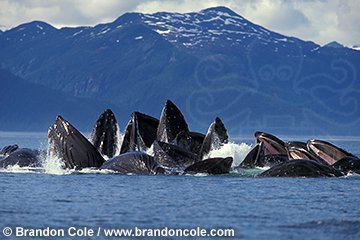
Scientists have been studying the humpback whale extensively for decades, researching among other things its 1) impressive yearly migration- up to 10,000 miles round-trip- from summer feeding grounds in high latitudes to mating and calving grounds in the tropics; 2) eerily beautiful mating songs, the animal kingdom’s most complex melodies; and 3) communal bubble-net feeding behavior. The latter is truly one of nature’s most amazing spectacles, a summer-long "all you can eat Alaskan buffet." Up to twenty whales circle underneath a school of herring, exhaling streams of bubbles which, upon rising, entrap and disorient the fish. Swimming upwards into the stunned mass of fish, the leviathans open wide and gulp hundreds of gallons of sea water and the herring snack it contains, erupting from the surface with cavernous maws agape.
Slow to recover from heavy losses in the early twentieth century, especially from the Antarctic whaling fleets and shore stations in the Southern Hemisphere, roughly ten percent of the pre-whaling era population estimate of 125,000 survive today. Sadly, this earns an "endangered species" badge even in our age of enlightenment.
One of the continuing mysteries in whale watching circles is exactly why whales jump clear of the water, or "breach". Does the thunderous splash resulting from a 40-ton bellyflop serve as some form of communication with other nearby whales? Could breaching be a threat display, or a show of dominance? A means of knocking off itchy barnacles, parasites and other skin irritants? Or could it be simply for the sheer fun of it? My guess is that all are possible explanations- especially the last! We honestly know so very little about these giants of the deep and their mysterious ways, but everything science has uncovered hints that cetaceans are intelligent, social animals, capable of a remarkable array of complex behaviors."
Scientists have been studying the humpback whale extensively for decades, researching among other things its 1) impressive yearly migration- up to 10,000 miles round-trip- from summer feeding grounds in high latitudes to mating and calving grounds in the tropics; 2) eerily beautiful mating songs, the animal kingdom’s most complex melodies; and 3) communal bubble-net feeding behavior. The latter is truly one of nature’s most amazing spectacles, a summer-long "all you can eat Alaskan buffet." Up to twenty whales circle underneath a school of herring, exhaling streams of bubbles which, upon rising, entrap and disorient the fish. Swimming upwards into the stunned mass of fish, the leviathans open wide and gulp hundreds of gallons of sea water and the herring snack it contains, erupting from the surface with cavernous maws agape.
Slow to recover from heavy losses in the early twentieth century, especially from the Antarctic whaling fleets and shore stations in the Southern Hemisphere, roughly ten percent of the pre-whaling era population estimate of 125,000 survive today. Sadly, this earns an "endangered species" badge even in our age of enlightenment.
One of the continuing mysteries in whale watching circles is exactly why whales jump clear of the water, or "breach". Does the thunderous splash resulting from a 40-ton bellyflop serve as some form of communication with other nearby whales? Could breaching be a threat display, or a show of dominance? A means of knocking off itchy barnacles, parasites and other skin irritants? Or could it be simply for the sheer fun of it? My guess is that all are possible explanations- especially the last! We honestly know so very little about these giants of the deep and their mysterious ways, but everything science has uncovered hints that cetaceans are intelligent, social animals, capable of a remarkable array of complex behaviors."
images and text via Brandon Cole


